We all face hardships at one time or another. But for people with disabilities, barriers can be more frequent and have greater impact. Aside from a physical environment that is not accessible, disabled people experience a lack of relevant assistive technology such as assistive, adaptive, and rehabilitative devices. A University of Sydney researcher is now developing wearable technology that people with disabilities can use to control devices, receive information and even register sensation.
Related New Stretchable E-Tattoo for Long-Term Uninterrupted Heart Monitoring
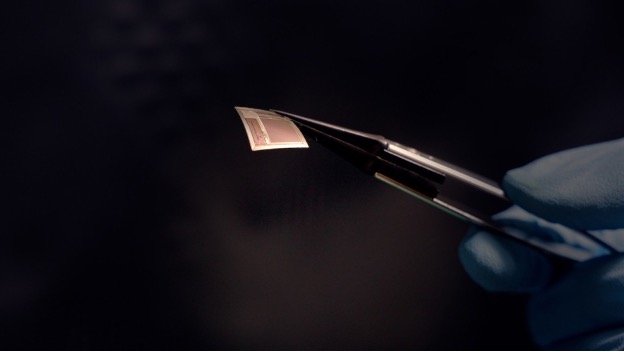
Anusha Withana from the University’s School of Computer Science, along with colleagues, is developing a super-thin, hyper-flexible sticky tape that can have electronic circuits printed onto it. Once applied, people could use it to control devices, receive information and importantly, register sensations through mobile phone-like vibrations. This could have benefits in robotics, education, game-playing and for people with disabilities, reports The University of Sydney.
Withana’s device, dubbed Tacttoo, is a printable electronic fake tattoo that can be personalized to specific needs. The Tacttoo is screen-printed with a circuit made from polymer-based conductive inks which can stretch and move with the skin, while all connections between the skin and the electronics are printed in skin-safe silver ink.

The sticky tape is only half the thickness of a human hair, making it the thinnest wearable tactile device to date. They are very cheap too. If mass-produced, it would cost less than 1 cent each.
Related Very Thin Tattoo-Like Wearable Patch Monitors and Diagnoses Health Problems from Sweat
“We want people to be able to wear it today and remove it tomorrow – and we want people to be able to create it themselves,” Withana says. “A broader user goal is to allow people with vision impairment to explore graphical information and more fully comprehend objects in museums and parks. This is something we’re looking at with a team from Monash University.”
The most innovative wearables event will be back on July 9-10 in beautiful San Francisco at SEMICON West to celebrate the 34th edition of the WT | Wearable Technologies Conference Series. Topics include data analytics in professional sports, prevention, treatment and rehabilitation with wearables, the future of digital health, medication and adherence, smart patches, workflow optimization and workforce safety and much more – featuring international leaders and experts of the wearables industry´s biggest names including Abbott, Autodesk, Datwyler, Kopin, Maxim Integrated, Multek, NFLPA, Omron, SharkDreams, Qualcomm, and many more.